
Language Matters when Naming Abuse

Credit: Met Gallery Open Source: The last words of Marie Antoinette, J. Pelicier 1794–1815
She reads a post that lists the signs of domestic violence. Every example involves being hit, pushed, punched (or worse). She’s never experienced any of those things. She closes the tab reassured that ‘at least’ whatever is happening in her home, it’s not that, and goes back to managing a partner whose unpredictable antagonistic moods she's learned to read with greater accuracy than an experienced meteorologist forecasts weather. The language used in the 'Facegram' post told her she didn’t qualify, so she stopped looking. But the harm to her kept accruing while the risks remained hidden.
This is why the words used matter. They decide who is allowed to recognise themselves in the descriptions and the lists. Three terms circulate constantly in the content women are exposed to regularly online: domestic violence, narcissistic abuse, and coercive control. They are often used as if they were interchangeable, however they’re not. The differences between each determine whether a woman is able to recognise her own situation clearly or files it under “not me” and carries on; confirming yet again that’s she’s overreacting just as her partner said she was.
Domestic violence isn’t the whole picture
In everyday use, and often in our own minds, “domestic violence” is associated with physical assault. A visible injury. A discrete event of violence with a before and an after. That picture is accurate as far as it goes, but it leaves out much of what the experience of coercive control actually is.
Coercive control is a pattern, not an incident. It is the sustained restriction of a person's freedom: her movement, her money, her contact with the people who know her, her confidence in her own judgement. Those restrictions are achieved by someone using coercive control through a deliberate application of words and actions that are designed to control through psychological, emotional, physical, social, and financial mechanisms. They can be overt or covert, obvious or subtle. Many of the harmful words and actions have been normalised across cultures and history; and many people have been conditioned to accept the harmful behaviours as ‘normal’ despite the significant harm they lead to. In recognition of the harm that coercive control patterns inflict, there are increasing jurisdictions around the world legislating these patterns as being a crime against another’s liberty when used in the context of an intimate partner relationship. Coercive control has been made a criminal offence in England and Wales under the Serious Crime Act 2015, in Scotland under the Domestic Abuse (Scotland) Act 2018, and in New South Wales and Queensland, the first Australian jurisdictions to do so, where the offence commenced in 2024 and 2025 respectively.[1] Each of these laws exists because the older definitions of domestic violence, built around physical assault and injury, missed the insidious pattern that does the most sustained damage.
These extremely harmful patterns of behaviour are built from many small acts that each, on the surface, can seem minor when considered as individual behaviours and only reveal themselves when viewed together systematically, over time. And much of it never involves physical violence at all. A woman waiting for a bruise before she takes her situation seriously may wait a very long time, because the thing harming her was never going to leave a mark. Social media click bait diagnostic ‘labels’ are a shifting landscape largely informed by algorithms instead of research evidence. A woman waiting to solve the diagnostic ‘puzzle’ of a partner is at risk of remaining stuck in pop psychology rabbit holes that serve to increase her self-doubt. Despite the gradual recognition of coercive control being criminalised, it’s important to recognise that some of harmful behaviour patterns may not meet the balance of proof required to be recognised as a ‘criminal offence’. A woman waiting to meet objective evidentiary requirements that a court would deem a prosecutable offence is in danger of dismissing the increasing risk of harm that ongoing exposure to even less ‘severe’ versions of these behaviour patterns pose to her as they accrue over time, as not being severe enough to warrant genuine concern. They do.
'Narcissistic abuse' moves the problem in the wrong direction
“Narcissistic abuse” has become increasingly popular because it feels like it explains everything at once: the charm in public, the reversals in private, the constant sense of being managed. But look at where it puts the problem. It locates the harm in her partner’s personality, in a presumed diagnosis, rather than in what he did and what it did to her. This applies equally to other popular explanatory labels that regularly appear in social media posts such as borderline, ADHD, sociopath, psychopath, attachment style; that seek to explain the harmful behaviour by labelling the person using the behaviour.
Narcissistic personality disorder is a clinical diagnosis. It can only be made by a qualified professional, about a person they have assessed clinically, and it describes a small number of people. A large number of people, on the other hand, exhibit traits of the narcissism criterion, and these can depend on context.
How many women have in a moment of frustrated exasperation thrown out the ‘you’re a narcissist’, only to have their partner point the same (or other) labels back at them.
How many women then ask themselves whether, in fact, they may be?
From over 20 years of working with women therapeutically, anecdotally my experience has indicated that many do. It simply keeps women confused for longer than they need to be. Most controlling partners don’t meet the full criteria for the disorder. When a woman's ability to name her situation depends on first deciding whether her partner is a narcissist (or some other diagnostic label), she has been handed a question she can’t answer and doesn’t need to. The bare faced ‘unsexy’ truth of it (one that isn’t likely to attract the validating ‘click bait’ of an insta post or Youtube reel) is that even a correct diagnosis won’t change what she can and should do next.
Coercive control asks nothing about a partner’s personality traits or psychiatric presentation. Instead, it describes an objective pattern of behaviour and its harmful cumulative effect on the person subjected to it. Whether her partner fits a label is beside the point. What matters most is whether a partner’s words and actions, taken together over time, have restricted her autonomy, decreased her self-worth, and made her world smaller. That is a question she can answer, from her own experience, without needing to diagnose anyone.
Three descriptions, three very different interpretations
The same three terms, side by side, show why the language we are given decides what we are able to clearly see.
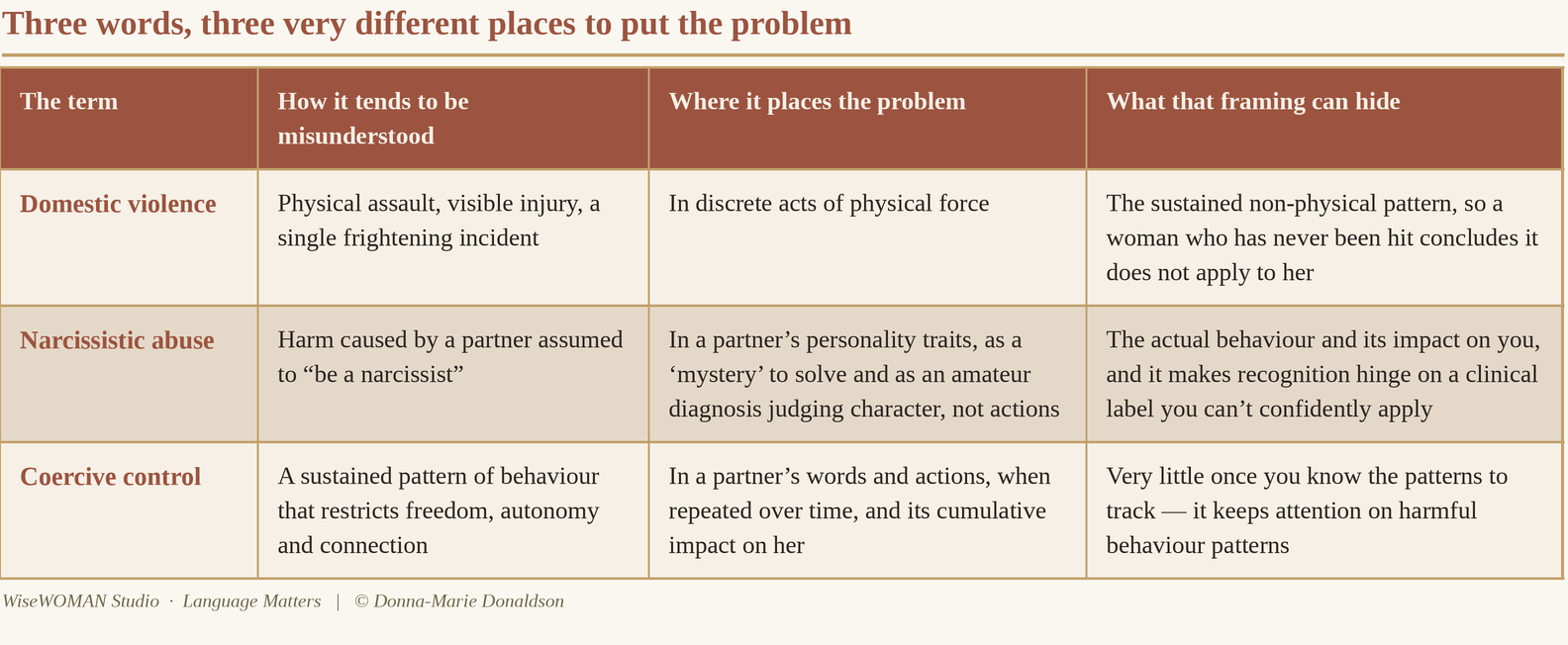
Locating harm in a personality, his or hers, keeps the behaviour out of view
There is a mirror image of the narcissist framing, and it lands on the partner being harmed. When coercive control isn’t accurately recognised, her distress is at risk of being read as being her personality. She’s anxious. She’s difficult. She’s too sensitive. She has “issues.” The harm done to her is suddenly filed as being a fact about her character. And she internalises those messages. Research on how these tactics operate is clear that self-blame is often evidence of coercive control impact rather than a pre-existing trait. In a narrative review published in Gender Issues, Cindy Veldhuis describes how coercive tactics work to cultivate dependence, denial and self-blame in the person subjected to them.[2]
Attempting to ‘diagnose’ one partner or the other where there is coercive control dynamics at play within the relationship, make the same error in opposite directions. One labels the controlling partner’s traits and character, and stops looking at the behaviour. The other diagnoses her and stops looking at the impacts of the behaviour. Coercive control is the language that refuses both detours and keeps the harmful conduct in full view. That is why the words are not a matter of preference or delicacy. Nor are they intended to construct a hierarchy or to judge which ‘words’ are better. “Domestic violence” can hide a pattern of psychological and emotional abuse that never turned physical. “Narcissistic abuse” can hide the behaviour behind a label of the person causing the harm. “Anxious” or “too much” can hide it behind a judgement on the woman being harmed. Only one of these four descriptions accurately recognises the experience of abuse within a relationship — in all its forms and regardless of either partners’ diagnosis, personality traits, or whether physical violence has occurred — coercive control.
What clearer language makes possible
Naming the pattern of abuse accurately is what makes it possible to track the pattern. The Relationship Clarity Mapping (RCM) method, exists to move the description of harmful experiences from being relegated to the ‘but he’s not always like that’ memory onto the page: the behaviours and her responses to them, dated, in sequence, so that what looked initially like a run of unconnected disagreements can be seen as the single pattern it is. One argument about money, or her phone, or where she had been, can always be explained away. Several of them, dated and connected to what followed each time, can’t be.
Having the ‘right’ words doesn’t decide anything on your behalf. It doesn’t tell you to stay, to leave, or to report. What it does is give you an accurate name for what’s happening and gives you the visual evidence of those repeated abuse patterns in front of you, which is the thing that has to come before any decision at all. A woman who believes the problem is her character, or is unsure whether her experience is severe enough to meet some external list decided by those not living her experience, or who is still waiting to work out whether her partner meets the criteria for a ‘narcissistic abuser’, is deciding nothing — because she’s not yet been allowed to clearly see what there is to decide about.
The words we are given decide what we’re able to see. That’s why the language isn’t incidental to the harm. It becomes part of it. Choose those words wisely.
My book, Patterns of Control: Understanding, Recognising and Tracking Coercive Control in Relationships, addresses this problem: the distance between the language available to describe coercive control and the reality of living inside it. It’s out now and available to buy on Amazon.
“A powerful and insightful book… provides victim-survivors and their therapists with greater clarity regarding their experiences while increasing awareness of the subtle, cumulative, and often hidden patterns that characterise coercive and controlling behaviours. Accessible yet grounded in practice. Highly recommended.”
— Dr Michelle Grover, Clinical Neuropsychologist
WiseWOMAN Studio is an educational resource for adult women aged 18 and over. It is not a clinical service, not therapy, and not a domestic violence crisis service. If you are in immediate danger, please contact emergency services or your local DV support service.
© Dee Donaldson | WiseWOMAN Studio
[1]Serious Crime Act 2015 (UK), s. 76; Domestic Abuse (Scotland) Act 2018 (Scot.); Crimes Legislation Amendment (Coercive Control) Act 2022 (NSW), offence commenced 1 July 2024.
[2]Veldhuis, C. B. (2024). Cultivating dependence, denial, and self-blame: A narrative review of the use and effects of coercive tactics in intimate partner violence. Gender Issues, 41, Article 10. https://doi.org/10.1007/s12147-024-09327-7